What Is a Variac / Variable Transformer ?
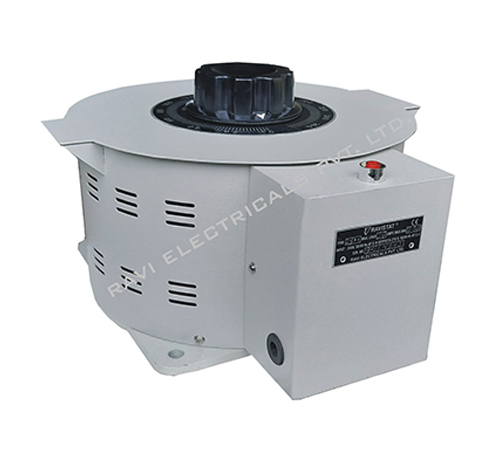
A Variac is a single winding transformer that uses a carbon brush that is mounted on a rotary system and taps to various points on the winding.
The output voltage is continuously varied by rotating the knob.
A Variac provides voltage control as opposed to a regular transformer (which only has fixed output).
The variac is a simple device to operate. Its aim is to increase or decrease the voltage entering it.In an example: When you are operating on a low input voltage, say 105 volts in AC, you can easily set the dial to give you the desired input voltage, say 120 volts. Your input voltage is excessively large (130 volts AC) it can be adjusted to a smaller value of the voltage you need (120 volts AC).
It is not automatic in voltage adjustment. That would be a line conditioner and it would be more costly.
The use of a variac with coffee roasters (you need a good thermometer to do this) is one application. The temperature of the coffee roaster can be manually adjusted by increasing or decreasing the output voltage of the variac fed to the coffee roaster. This enables a low-cost coffee roaster to compete with the roasting capability of far more costly coffee roasters.
How Variac Transformer Works
Variac transformer works on electromagnetic induction principle. It consists of one tapped wound on a toroidal core. Depending on the rotation of the winding with respect to the core, the number of turns that are coupled to the magnetic flux may be altered, hence altering the output voltage. This gives the opportunity to adjust the output voltage gradually and linearly between 0 and the maximum value.
Key Characteristics and Parameters of Variac Transformer
1. Voltage Regulation:
The first feature of a Variac transformer is the fact that it
can offer continuous voltage regulation. The number of effective
turns in the secondary winding can be varied by moving the brush
or tap along the winding and this leads to a similar change in
the output voltage.
2. Input and Output Voltage Range:
Variac transformers are normally designed to operate within a
range of input voltages, e.g. 120 V or 240 V for Single Phase
and 415V to 0-470Volt for Three Phase. depending on the design
of the transformer and windings, output voltage may be zero or
slightly higher than the voltage on the input.
3. Current Capacity:
The current capacity of Variac transformer depends on the area
of the winding that cross-section, and the core material. The
transformer should be used within the current limit that has
been rated to avoid overheating and possible destruction. The
Current capacity which we manufacture is 1Amps to 1000Amps
4. Efficiency and Power Loss:
Variac transformers like any other transformer are prone to
power loss through winding resistance, core losses, and stray
losses. The efficiency of Variac transformer is generally lower
than that of conventional transformer because of the extra
losses linked with the swerving winding arrangement. Generally
it is 97% efficient and losses should be less than 2%.
5. Insulation and Dielectric Strength:
Variac transformers should be insulated and have sufficient
dielectric strength to withstand voltage stresses between the
dielectric core and the windings turns. This is especially with
high voltages or in harsh environments.
6. Mechanical Construction:
Mechanical construction of a Variac transformer is very
important to its performance and durability. The brush or tap
mechanism should be made in such a way that it operates smoothly
and reliably whereas the winding and core assembly should be
durable and vibration and environment resistant.
Types of Variac Transformers
1. Manual Variac Transformers:
These types of transformers necessitate the use of a person to
move the brush or tap with the goal of varying the output
voltage. They are mostly applied in laboratories or in places
that do not need a frequent change in voltages.
2. Motorized Variac Transformers:
These transformers have a motor incorporated of 240Volts or
120Volts as per requirement and thus the position of the brushes
or tap can automatically be changed and the output voltage can
be remotely or automatically controlled. They would be
applicable in situations that require frequent or constant
adjustment of voltage. The torque would be as per current rating
of the Transformer. Standard Motor rotation is 0-8 seconds for
AIR cooled Transformers. And for OIL cooled it is 27seconds.
3. Digitally Controlled Variac Transformers:
Digital control can be provided on advanced Variac transformers
with MFM, which allows fine control of the voltage and
monitoring of the voltage, either through digital interfaces or
computer control.